Choosing an electric screwdriver for your assembly line means evaluating tools for so much more than torque and speed, especially in a production environment. The motor technology behind the tool plays a critical role in how it performs over time, and the wrong choice can lead to excessive heat, frequent maintenance, and unexpected downtime that disrupts your operations.
For production managers and maintenance supervisors, deciding between brushed vs. brushless electric screwdrivers directly impacts tool life, maintenance intervals, energy efficiency, and long-term cost of ownership.
What’s the Difference Between Brushed vs. Brushless Electric Screwdrivers?
 Download Infographic
At a high level, the difference between brushed and brushless electric screwdrivers comes down to how the motor is powered and controlled. That difference affects durability, efficiency, and suitability in assembly operations. Understanding how each motor type works makes it easier to determine which is the better fit for your unique application.
Brushed Electric Screwdrivers: How They Work and Where They’re Best Used
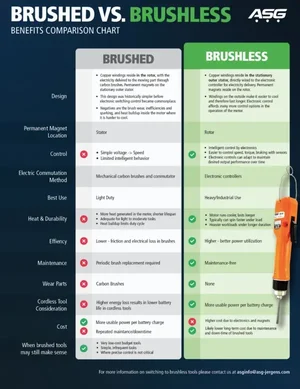
Brushed electric screwdrivers use carbon brushes and a commutator to transfer electrical current to the motor. The copper windings are located in the rotor, while permanent magnets sit in the stator. This mechanically simple design has been used for decades and helped make brushed tools widely available and cost-effective.
Key characteristics of brushed electric screwdrivers:
- Mechanical commutation using carbon brushes
- Simple voltage-based speed control
- More heat generated due to friction and electrical loss
- Brush wear limits duty cycle and service life
Because of these factors, brushed tools are typically best suited for light-duty or intermittent applications.
Brushless Electric Screwdrivers: How Electronic Control Improves Performance
Brushless electric screwdrivers eliminate physical brushes entirely. Instead, electronic controllers manage commutation, with copper windings located in the stator and permanent magnets mounted on the rotor. This design significantly reduces friction, heat, and wear while allowing for precise electronic control of speed and torque.
Key characteristics of brushless electric screwdrivers for industrial assembly
- Electronic commutation (no brushes or commutator)
- Intelligent electronic speed and torque control
- Motor runs cooler and lasts longer
- Higher power utilization and efficiency
Because brushless motors adapt electronically to maintain performance under load, they are better suited for industrial and high-demand assembly environments.
When to Choose Brushed vs. Brushless Electric Screwdrivers for Assembly Applications
Choosing between brushed and brushless electric screwdrivers depends on production volume and performance expectations. Each technology still has a role, but those roles are increasingly different.
When Brushed Electric Screwdrivers Still Make Sense on the Assembly Line
Brushed tools remain a good choice in manufacturing environments where production demands are limited, and cost sensitivity is high. Typical brushed screwdriver use cases include:
- Low-volume or infrequent fastening tasks
- Simple applications without strict torque accuracy requirements
- Budget-driven tool replacement for legacy systems
However, brushed tools require periodic brush replacement and experience more heat buildup and sparking, which limits continuous use.
Brushless Electric Screwdrivers Are the Better Choice for High-Volume Assembly
Brushless electric screwdrivers are designed for manufacturing environments where uptime and consistency are critical. Common brushless screwdriver use cases include:
- High-volume or continuous production lines
- Longer duty cycles and heavier workloads
- Applications requiring consistent torque output
- Operations focused on reducing downtime and maintenance
Because brushless tools can maintain torque and speed under load and produce less heat, they are better suited for demanding assembly operations.
Matching Motor Technology to Assembly Stations
The choice between brushed and brushless electric screwdrivers often becomes clearer when evaluated at the station level, where torque requirements and duty cycles vary significantly.
For example, in electronics assembly, medical devices, and small component fastening, torque requirements typically fall in the 2–20 lbf-in (0.2–2.3 Nm) range. These stations prioritize precision, repeatability, and operator comfort, making brushless electric screwdrivers the obvious choice on the assembly line.
Why Brushless Electric Screwdrivers Are Becoming the Standard in Manufacturing
Brushless technology has become the preferred choice in many manufacturing facilities due to several measurable advantages:
Reduced Heat and Increased Durability
Brushed motors generate more heat due to brush friction, while brushless motors run cooler, allowing them to support longer duty cycles, handle heavier workloads, and deliver a longer tool life.
Lower Maintenance and Reduced Assembly Line Downtime
Brushed tools require carbon brush replacement as part of routine maintenance. Brushless tools eliminate this wear component entirely.
Although brushless electric screwdrivers have a higher upfront cost, they typically offer a lower total cost of ownership due to fewer tool failures and less unplanned downtime.
How to Choose the Right Electric Screwdriver for Your Operation
In addition to performance requirements, it’s important to consider how motor technology is evolving across the industry. For example, HIOS has officially discontinued its brushed electric screwdriver platforms, including long-running CL, VZ, and VB series, as part of a broader shift toward brushless platforms designed for higher efficiency, longer tool life, and next-generation technology.
According to HIOS, legacy brushed designs present inherent challenges in modern manufacturing environments, including carbon brush dust generation, periodic maintenance requirements, and increased safety management concerns associated with high-voltage operation. At the same time, growing emphasis on durability, energy efficiency, environmental impact reduction, and traceability has accelerated the transition toward brushless motor platforms.
For facilities currently using HIOS brushed tools, reviewing our substitution guide can help simplify future replacements and support evolving production demands.
Working with an experienced fastening partner like ASG can help ensure your electric screwdriving solution aligns with both current production needs and long-term scalability, while also accounting for industry trends and product lifecycle changes.
Recent Posts
 ASG’s New Engineering and Sales Team Members
 Is It Worth Going to The ASSEMBLY Show? Here Are 4 Reasons to Say Yes and Stop by Booth 531!
 Can’t Make It to the Tradeshow? No Problem … We’re Bringing the Show to You.
 ASG And PICO Partner Up To Give You Money
 ASG Announces Bold Rebrand: “Just Screw It”
 Mike Barnes Appointed General Manager of ASG
 ASG SmartBench Offers Solutions for Complex Assembly Lines